


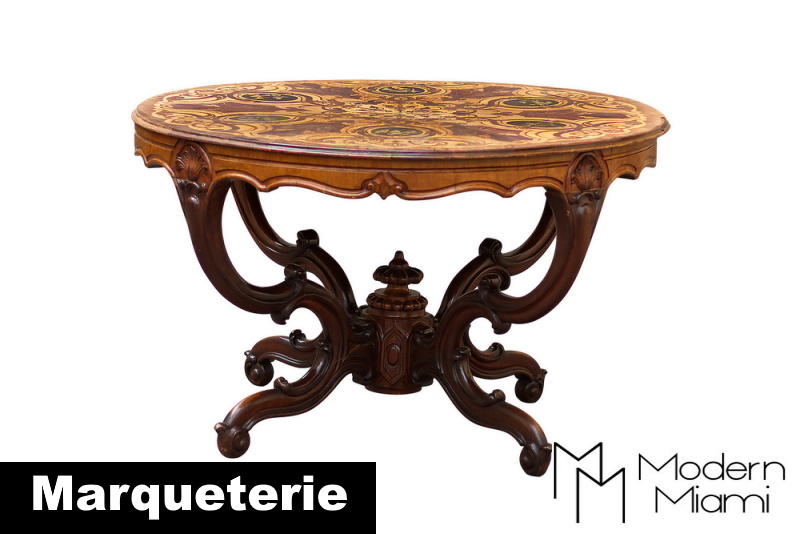
Marqueterie (Marquetry) is the practice of putting designs, patterns, and images on veneer pieces to decorate furniture, panels, flooring, and small ornamental things. Marqueterie was used to indicate status and riches. Marqueterie increases an object’s worth and aesthetic appeal. The boundaries and dimensions of a room can be highlighted by marqueterie.
Where did Marqueterie Come From?
Naples and Florence in the 16th century had an influence on the veneer marqueterie craft. The process of marqueterie was influenced by the inlaying methods used in Florence, which involved solid marble pieces embellished with jaspers, semiprecious stones, and fitted marbles. Additionally, at this time, the art of wood marqueterie blossomed in Antwerp and spread to France in the middle of the 17th century to adorn opulent furniture. Famous cabinet manufacturers Pierre Golle and André-Charles Boulle used marqueterie in their creations.
In the 1750s, floral marqueterie was frequently employed on furniture in Paris, especially by cabinetmaker Bernard II van Risamburgh, Jean-Pierre Latz, and Simon-François Oeben. The Bureau du Roi, a famous piece of royal French furniture, was created by Jean Henri Riesener and featured veneer marqueterie.
What Material is Commonly Used for Marqueterie?
The most common material used to make marqueterie is wood (mahogany, walnut, oak, ash, merbau, and wenge). Ivory, bone, marble, tortoiseshell, jewels, and metals may also be combined with wood to create unique designs in marqueterie.
What are Modern Methods of Creating Marqueterie?
The simplest marqueterie technique involves temporarily joining two sheets of veneer together, then cutting those pieces to create two identical panels. Knife-cut veneers are used in more modern marqueterie, which often take longer to complete. As a result, scroll saw or fret techniques were developed. To give images a three-dimensional appearance, sand-shading is used. Another way to create a marqueterie is to engrave delicate lines into a painting, then fill the engravings with a mixture of shellac and Indian ink.
In the 1980s, Georges Vriz developed the VRIZ process. This involves stacking two veneer layers on top of one another and sanding the top layer until fiber transparency is reached.
Marqueterie has been produced using more recent techniques, like laser cutting. The design is converted into a CAD or vector file, and each piece is cut out separately using a calibrated beam power for the type and thickness of the wood.
