


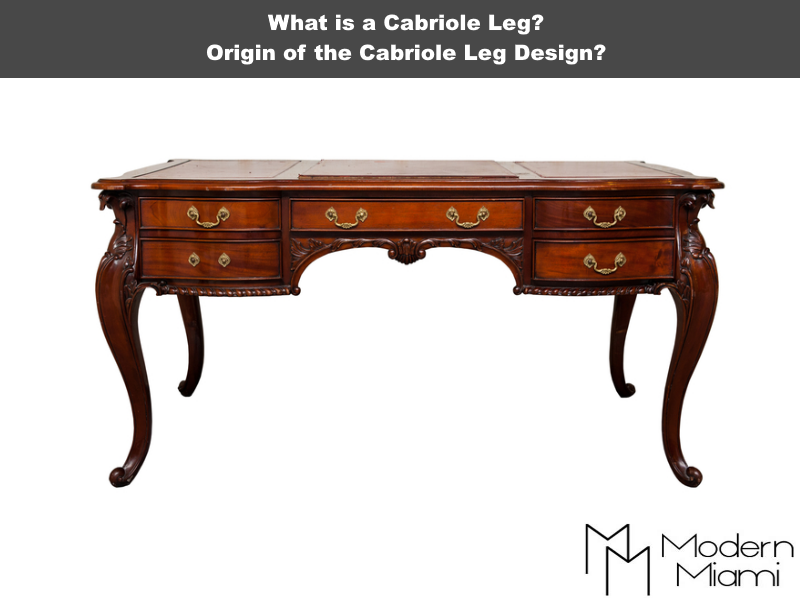
The cabriole leg of 18th-century furniture is shaped into an upper, outward convex curve and a lower, inward concave curve. The pad or club foot is gently folded under a basic cabriole leg. The foot of a carved cabriole leg is frequently embellished with a lion’s claws or eagle’s talons that are holding a ball or orb. Cabochons, which are typically located at the knee of the leg and are engravings that resemble leaves or wings, are seen on cabriole legs.
What is the Origin of Cabriole Leg Design?
Although frequently linked to 18th-century English furniture, the cabriole leg was first used in China and ancient Greece. Chinese lacquered tables most usually have cabriole legs. The cabriole leg, which was modeled after a graphic scroll motif found in 1700s French art, was a component of the Rococo style in France.
During Queen Anne’s rule in Great Britain, the cabriole leg saw increased popularity. From 1712 through 1760, Queen Anne-style furniture was widely used featuring the cabriole leg. The Queen Anne cabriole leg chair frequently included a bun or pad foot, a back adorned with hoop ornaments, and a splat shaped like a vase. The cabriole leg was introduced in 1750 in Chippendale furniture in a more delicate shape than the Queen Anne Style.
American cabriole leg designs from the middle of the 18th century combined Queen Anne, George I, and George II furniture elements. The padded foot is the American cabriole leg’s most distinguishing feature.
How is the Cabriole Leg Constructed?
The first step in building a cabriole leg is to draft out a template on cardboard or hardboard. The cabriole leg’s “S” shape is more obvious or “bowed,” making it structurally weaker. Solid wood must be used for the cabriole leg rather than laminate. For some of the first rough turning, a lathe may be utilized. Eventually, a bandsaw will be required due to the complicated arc forms in the design. The applications for the spokeshave, rasp, and scraper follow. The foot of the cabriole leg may have a bun, ball, or “ball and claw” variety. With screws or dowels, the tiny brackets are fastened to the other wood piece.
What are Famous Cabriole Leg Designs?
A number of important historical antique furniture collections feature pieces with the traditional cabriole leg form. It was rumored that Henry Cavendish owned a collection of couches and chairs with cabriole legs.
The Gloucester cherry candlestand, which the Essex Institute estimates was created between 1725 and 1750, is another well-known piece of furniture with cabriole legs. This furniture is significant for its early design of the legs’ dovetailed connection as opposed to later periods’ dowelled connection.
