


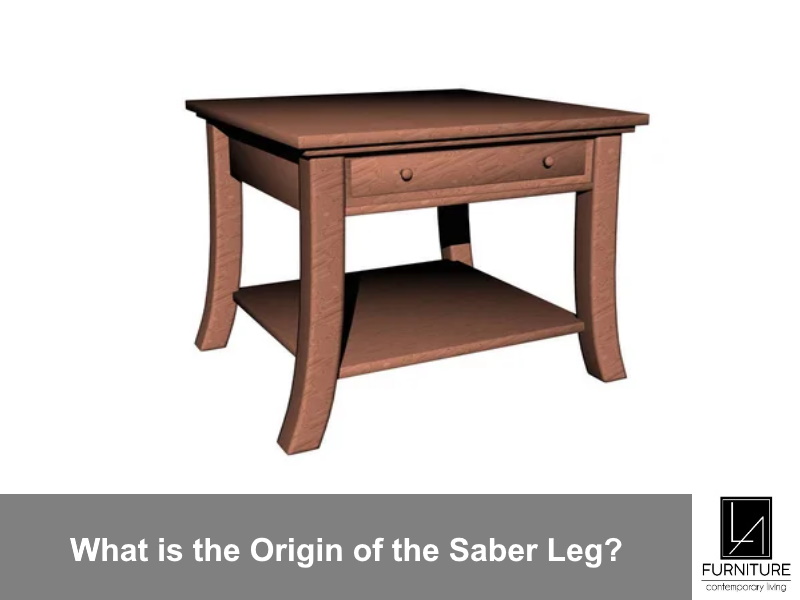
The saber leg of a piece of furniture features splayed legs that curve outward, forming a concavity, and resembles a saber. Furniture such as chairs, stools, and sofas can have saber leg styles. The saber leg may be rounded or squarish and often tapers.
What is the Origin of the Saber Leg?
The saber leg originates from the klismos chair used by ancient Greeks in the 5th century BC. The klismos chair has two back support rails that go up to connect to a single concave backrest. The saber leg comes from the outwardly directed legs of the klismos chair which can turn perpendicular or parallel to the chair seat.
The saber leg design became more widely used during the 18th and early 19th-century British Regency and American Empire furniture periods. The saber leg is sometimes known as the “swept” or “Waterloo” leg. Together with the cabriole leg, the saber leg is one of the most commonly incorporated furniture designs in modern furniture from antique styles.
Who Famously Used the Saber Leg Style?
Thomas Sheraton was a renowned English furniture designer in the 18th century who made use of the saber leg style in his furniture designs. The Sheraton style is famously related to the furniture of the 1790s and early 19th century.
What are Other Antique Furniture Legs?
Different furniture leg types can be used to identify and date antique pieces from a variety of eras in addition to being an essential component of the overall look and functioning of furniture. The saber leg belongs to a category of antique leg furniture which is still used in modern furniture today.
Antique furniture leg designs come in various styles as listed below.
- Cabriole leg– common in the 1700s, the of this furniture leg curves outward while its ankle curves inward. Queen Anne and Chippendale furniture feature cabriole legs.
- Fluted leg– takes after Greek columns showcasing a series of rounded grooves of channels carved into the furniture leg. Hepplewhite 18th-century furniture has fluted legs.
- Spiral leg– resembles a twisted rope common in William and Mary, Restoration, Empire, and Federal furniture
- Marlborough Leg– plain design with a straight and square form which may have carved designs. Late 18th-century Chippendale furniture has this type of leg.
