


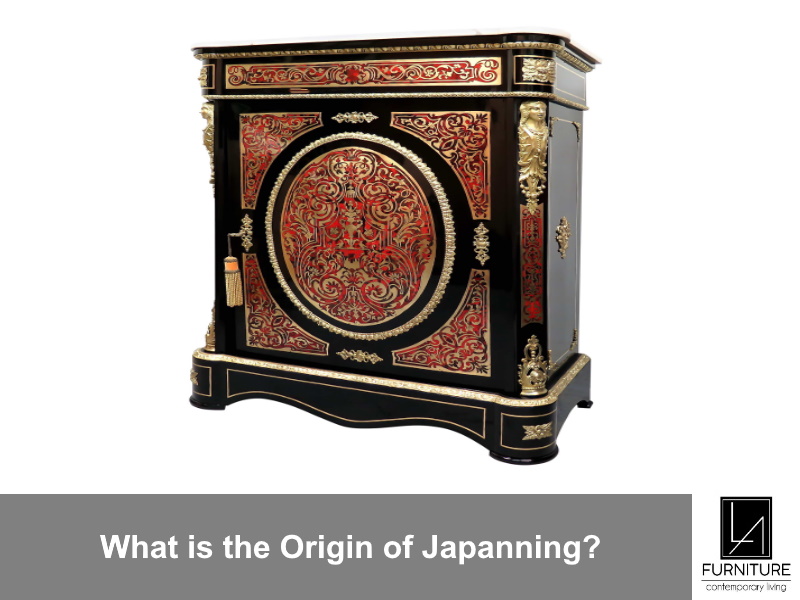
Japanning is the process of decorating furniture and other pieces with lacquer and resin. Japanning originated from East Asia and was imitated by Europeans in the 17th century. Wolverhampton and Bilston were famous centers of japanning until their decline in the middle of the 19th century.
What is the Process of Japanning?
Japanning is the process of decorating and treating antique furniture using resin and lacquer. Japanning had its roots in Europeans who mimicked lacquer-work from East Asia. Japanning was initially used on furniture and made use of a rich black lacquer as a base. Gold accents are used to create unique patterns on japanned pieces.
What is the Origin of Japanning?
The japanning process originated in India, China, and Japan. By the 17th century, East Asian lacquerwork reached Europe and developed a high demand. The Italians then started to mimic the technique of Asian lacquerwork. The European japanning method applies layers of heat-dried varnishes with a resin base. The base is similar to shellac and produces a glossy, smooth finish. European japanned items come in green, blue, and red colors. European japanning was described in Stalker and Parker’s Treatise of Japanning and Varnishing released in Oxford in 1688.
In the United States, Colonial Boston was a huge trade market for japanned products.
Well-known Centers of Japanning?
Bilston and Wolverhampton were distinguished centers for the production of japanned goods. In the 1818 trade directories, 20 firms of japanners were recorded in Wolverhampton and 15 in Bilston.
Up until the mid-19th century, japanning was highly popular. Almost every middle-class family owned a japanned piece. This changed in the 1880s when the demand for japanning and tin-plating declined. The japanning industry in the West Midlands had almost disappeared by the 1920s.
The newly developed bicycle and automobile sectors saw a large increase in the supply of japanned metal. John Marston, whose japanning business began producing bicycles in 1887, was the most prosperous of these. The business’s bicycle manufacturing division swiftly outperformed its decorative japanning production. Marston’s japanned bicycle became known as the Sunbeam produced by his factory called Sunbeamland.
