


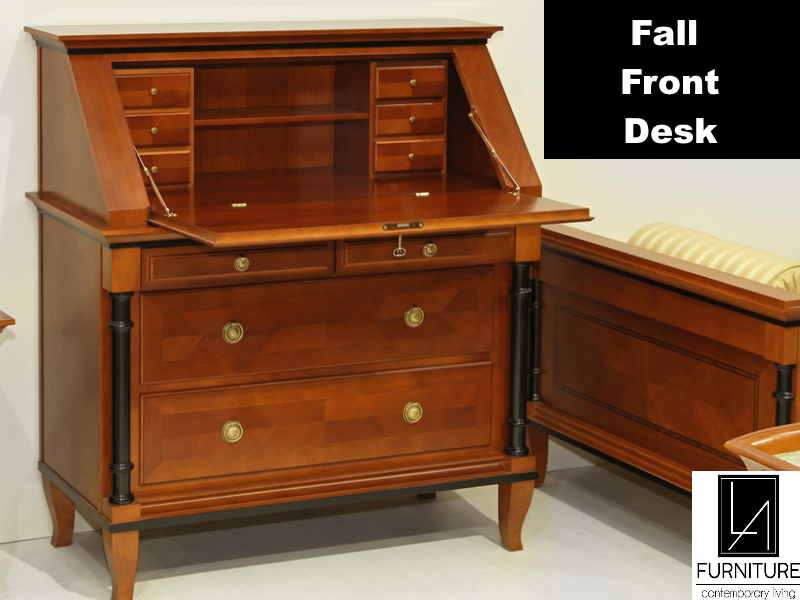
A fall front desk is cabinet furniture with drawers or doors at the base and a hinged lid that functions both as a writing table and cover for interior compartments and shelves. It is often associated with the secretary desk, however, the fall front desk’s writing panel is aligned vertically well when closed compared to the secretary desk.
What is the History of the Fall Front Desk?
Fall front desks were created in 16th century Europe and were known as “vargueno” in Spain. The fall front desk started as a cabinet with a vertical front panel connected to an open stand. Hinges are used to connect this panel to turn it into a writing table. In the 17th century, Prince William commissioned Dutch cabinet makers for a fall front desk that would remain closed even without a lock or latch which resulted in the slant front desk.
The fall front desk reached its height in the late 18th century with cabinet makers such as Samuel Prince, Benjamin Frothingham, and John Cogswell adapting Queen Anne and Chippendale designs.
The fall front desk lost its popularity by the mid-1800s and made a comeback in the mid-20th century.
What is the Modern Fall Front Desk?
Classic and modern designs of fall front desks continue to be in use today. The fall front desk remains a piece of functional furniture that provides ample storage space, a fold-away surface for devices, and small drawers for items such as jewelry and accessories.
Classic fall front desks are made of walnut, maple, and cherry. More valuable fall front desks are constructed out of imported mahogany with supporting and interior structures made of pine or birch. Modern reproductions are lighter and use metals, staples, or plastic drawer slides as attachments. The paneling and interior are made of plywood or particleboard.
